
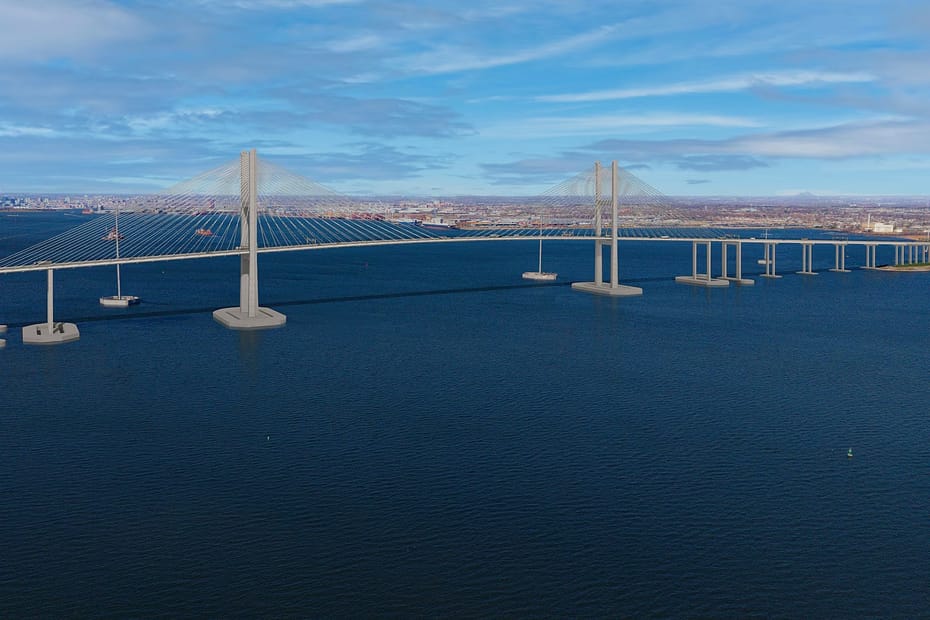
On March 26, 2024, Maryland experienced a catastrophe of epic proportions when a cargo ship leaving Baltimore Harbor plowed into the iconic Francis Scott Key Bridge.
The catastrophe had measurable negative human impacts and measurable negative economic impacts.
Six workers doing maintenance on the bridge died when the bridge collapsed.
For almost two months, debris from the collapsed bridge blocked shipping to and from the Port of Baltimore
That impact went far beyond Baltimore.
The port is an economic engine that employs 15,000 people and indirectly supports 140,000 others annually.
It also helps to generate $3.3 billion in wages and salaries, $2.6 billion in business revenue, and $400 million in state and local tax revenue.
Almost a year after the bridge collapse, Congress agreed to provide federal funds for rebuilding the bridge. The amount was based on estimated costs ranging between $1.7 billion and $1.9 billion. The expectation was that a rebuilt bridge would be opened in 2026 (two years after the former bridge fell).
There has not been much positive news since then.
Recent media reports indicate there are serious issues on the rebuild with cost overruns and construction schedule delays.
This is not a surprise, as cost overruns and delayed schedules on government funded infrastructure, projects are standard operating procedure.
The Key Bridge project is no different. The previous projected costs of $1.7 to $1.9 billion are now projected to be $4.3 billion to $5.2 billion. The project completion schedule has also changed. The projected reopening of the bridge has gone from 2026 to late 2030. Expect more going forward.
The Maryland Transportation Authority (MDTA) that owns the remains of the Key Bridge has already acknowledged this reality by citing figures from the Federal Highway Administration, showing that highway construction costs have risen approximately 72% over the past five years.
A critical unresolved issue on funding and on schedules is the outcome of litigation over suits filed by Maryland after suing the cargo ship owner for negligence.
Those claims may be hard to prove.
The lawyers for the cargo ship ownwers and their insurer could focus on a recent announcement from The Chair of National Transportation Safety Board (NTSB) that MDTA had not assessed the Key Bridge that could have warned of its vulnerability from a vessel collision. The Chair said “Not only did MDTA fail to conduct the vulnerability assessment on the Key Bridge, they did not provide, nor were they able to provide NTSB the data needed to conduct the assessment. We asked for that data, they didn’t have it. We had to develop that data ourselves.”.
The NSTB chair concluded had the assessment been completed, “the MDTA would’ve known the risk and could’ve taken action to prevent the collapse.
The cargo ship owners and insurers can and probably will also argue that the cargo ship had undergone 27 safty inspections before arriving in Baltimore including two in 2023, one in June in San Antonio, Chile, where a fuel-pressure gauge was repaired, and the second in September by the U.S. Coast Guard in New York, which found no problems.
They may also reference an article from the Washington Post where a former senior Maryland Transportation Authority (MDTA) official said “It never occurred to anybody” that a ship traversing the narrow channel might lose control and strike a critical support structure.
All the above leads me to offer a suggestion that before any further efforts are made to rebuild the Key Bridge.
DO NOTHING MORE
Do nothing more unless and until there is certainty on the funding for a rebuild and certainty on future cost overruns are covered.
Some may say moving forward on a Key Bridge rebuild is essential since approximately 30,000 vehicles crossed the bridge daily, including trucks that were hauling hazardous materials and are barred from the two harbor tunnels.
I once was a regular user of the Key Bridge when I travelled from the Eastern Shore to Baltimore and points north.
Now I, along with other former Key Bridge users, have found alternative routes including the Fort McHenry Tunnel, the Baltimore Harbor Tunnel and The Baltimore Beltway.
For the last four years, and for at least the next four years, everyone who has used the Key Bridge before the bridge collapse, will continue to utilize alternative routes. Does that inconvenience, which was the status quo before the Key Bridge was open to traffic in 1977, merit a bridge that cost at least $4.3 billion to rebuild?
I think not, especially when the state has been, and will continue to face enormous challenges in allocating state transportation funding where it has the greatest return on investment.
Do nothing more.
Certainly not now, not the immediate future, and maybe not ever.
Maryland has been and continues to face challenges and difficult decisions on where to spend money on infrastructure.
Government simply cannot do everything. What we can and must do is engage in open discussions, deliberations, and decisions on how best to prioritize where to invest tax dollars in infrastructure.
Governor Moore recognizes this. He has been an ardent supporter of using light rail as an option for ared line transit expansion in Baltimore City. Now there are reports he is considering a less expensive bus system instead. That pivot is based in part due to higher costs than expected for the light rail option and uncertainty on federal funding amounts.
The real question for now is, should Maryland rebuild a bridge costing at least $4.3 billion and almost certainly more, for users who have already been using alternative travel plans for the last two years will continue to do so for at least the next four years and probably longer.
Now is the time to heed the wise counsel of Peter F. Drucker: “Few things are more worthless than doing things well that should not have been done in the first place.”