
The College Art Association established in 1972 the Women’s Caucus for Art and the Committee on Women in the Arts. Women Artists: 1550-1950, at the Los Angeles County Museum (1976) was the first major international exhibition in America of art made by women. It included works by 83 women artists and published an exhibition catalogue that contained mostly black and white photographs. Artist Frida Kahlo was the only woman of color represented in the exhibition.
On a visit to Vienna in the 1970s, art collectors Wilhelmina Holladay and her husband purchased a still life by the 17th Century Flemish artist, Clara Peeters. Unable to find information about her, or other women artists in current art history books, Holladay began to seek out paintings and information on the artists. With the Holladay’s support, the National Museum of Women in the Arts, the first such museum in the world, was opened to the public on April 7, 1981. Since then, works by women artists have been added to museum collections world-wide.
“Still Life with Apples, Pears, Cucumbers, Figs and a Melon” (1625-30)
The National Gallery in Washington DC has recently acquired three works by 17th Century women artists. “Still Life with Apples, Pears, Cucumbers, Figs and a Melon” (1625-30) (14’’x23’’) (oil) by Italian artist Fede Galizia (1573-1630) was purchased in 2022. Born in Milan, she was trained by her father Nunzia Galizia, a miniaturist. She started painting at twelve and earned an international reputation as a portrait painter by the time she was 18 years old. Paolo Morigia, a notable Jesuit scholar, commented that her portrait of him offered “clear and evident signs of [her] becoming a truly noble painter of such excellence, and such good likeness, that one could not desire anything more.”
Portraits and paintings of religious subjects were not new. But the still life was new. Milan was the center for the Catholic Reformation. The city also was a center of science. The microscope had been invented in 1590. “Still Life with Apples, Pears, Cucumbers, Figs and a Melon” illustrates Galizia’s attention to minute detail: the knobby skin of cucumbers, the rough skin and seeds of the cut melon, and apples spread out across the wood table. The yellow melon at the right is balanced on the left with the intricate detail of a woven wicker basket filled with apples and pears. The variety of green apple and pear leaves lead the eye around the composition. Highlights on the edges of the white bowl draw attention to the dark figs. Fruit does not last forever, so Galizia added a few blemishes and flies. In this religious community, a reminder of the beauty of nature also is a reminder of the shortness of life.
“Moses ter Borch Holding a Kolf Stick” (1655)
“Moses ter Borch Holding a Kolf Stick” (1655) (16”x10”) (oil) was painted by Dutch artists Gesina ter Borch (1631-1690) and her half-brother Gerard ter Borch the Younger (1617-1681). Both were taught by their father. Gerald ter Borch became the sought-after artist. Gesina was eclipsed by him in art history because she was a woman. Several drawings and watercolors by Gesina provide evidence that she participated in making some of Gerard’s paintings. “Moses ter Borch Holding a Kolf Stick” is a portrait of their younger brother. Gerard probably designed the composition, but Gesina was the painter. Gesina’s skill is evident in Moses’s charming attitude, a little interested but a little put out by the bother. Moses is identified by his curling red hair and his snub nose. The detailed variety of textures of his clothing is remarkable. He is a fashion statement. He is bundled for winter in a furry sheepskin and hat. He wears a dark leather, long-sleeved, knee-length jacket with buttons, topped by green wool wrap. His light brown under tunic has a decorative border. His outfit is completed with square-toed, black leather boots with red ribbons, high fashion at the time. He holds a Kolf (golf) stick; a ball lies on the ground. Netherlanders played Kolf as early as the 13th Century, on the ground and in the winter on the ice. The National Gallery acquired this painting in 2023.
#3 “Annunciation” (1677)
Also in 2023, The National Gallery acquired “Annunciation” (1677) (5.25’’x7’’) by Florentine artist Caterina Angela Pierozzi (active c.1670-1690). Little is known about her. She was probably taught by her uncle. Her husband was the painter Michelangelo Corsi. She was accepted into the Accademia di San Luca in 1684. Vittoria della Rovere, the Medici Grand Duchess of Tuscany (1622-1694), was an important patron. “Annunciation” (1677) is the only known work by Pierozzi. Her name and date are recorded on the border of the painting. Archangel Gabriel has delivered the message that Mary will give birth to a son, Jesus. Mary looks up in acceptance. The spectacular flower border contains pinks, lavender, and blue flowers, favorites of the Medici. The family commissioned several paintings of the Annunciation. They were the custodians of what was considered a miraculous painting in the Basilica della Santissima Annunziata in Florence: the monk who had been painting the fresco fell asleep, and when he awoke, it was completed.
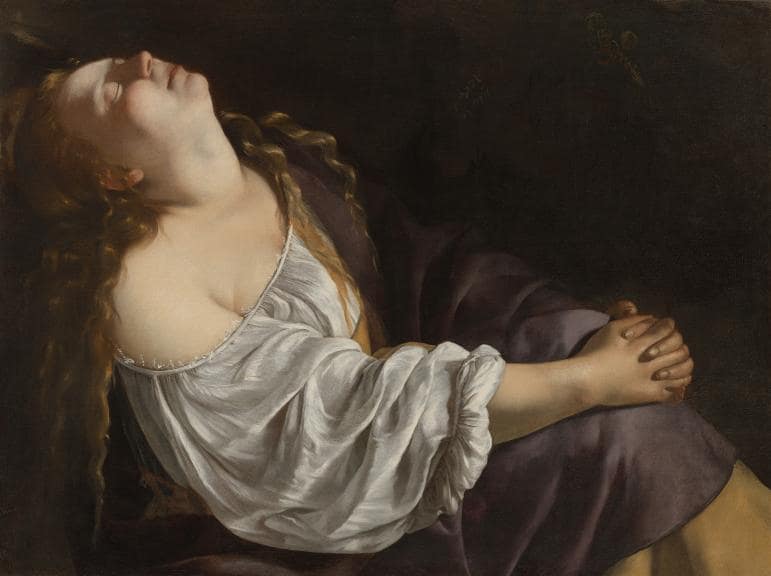
“Mary Magdalene in Ecstasy’’ (1625)
On February 4, 2026, the National Gallery of Art announced the acquisition of “Mary Magdalene in Ecstasy’’ (1625) (32”x42”) by Artemisia Gentileschi (1593-c.1656). Born in Rome, she was taught to paint by her father, the well-known painter Orazio Gentileschi (1563-1639). When Artemisia was 19, her proud father said, “Artemisia has in three years become so skilled that I can venture to say that today she has no peer…” She lived in Florence from 1613 until 1620. The Medicis and others were her patrons.
“Mary Magdalene in Ecstasy’’ is considered to have been painted when she lived in Rome (1620 -1627). Her work was influenced by the new Baroque style created by Caravaggio. Strong physical action and emotion replaced the calm meditative works of the Renaissance. Deep rich colors and chiaroscuro, strong light and shadow, replaced the pervious sunny landscapes. Artemesia employs all of these new devises. Although she was capable of painting any subject, she is known for her paintings of women from history, mythology, and the Bible in emotional situations. According to a legend, after Christ’s death, Mary Magdalene retreated from the world and lived as a hermit. Seven times a day angels lifted her to heaven where she experienced heavenly bliss. The subject was popular in 17th Century Italy, and Caravaggio painted one in 1606. Artemesia painted a close up of Mary Magdeline that occupies almost all the canvas, except for the mysterious dark background. However, Magdelene is bathed in light. Head thrown back and hands clasped around her knees, she is experiencing physical and spiritual ecstasy.
“We are thrilled to announce this acquisition by Artemisia Gentileschi, one of the most important artists of the 17th century.’’ (February 4, 2026, NGA press release)