Photo by Jeff McGuiness
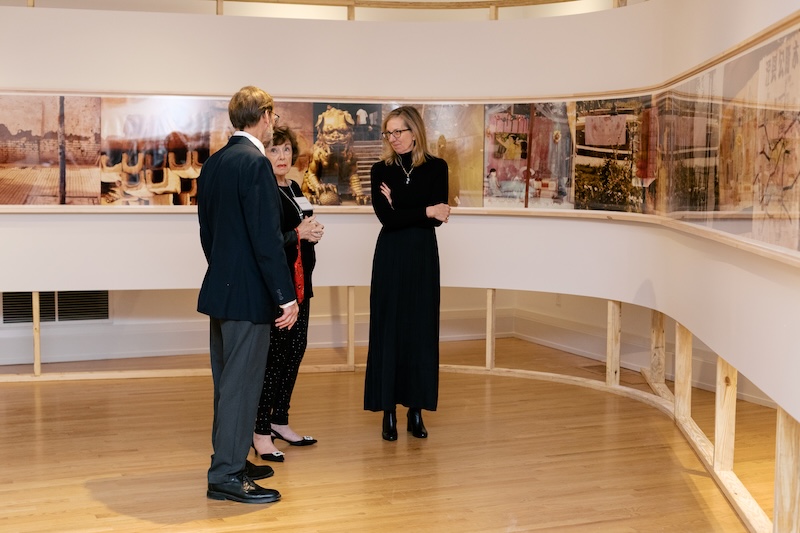
“Bear Me Into Freedom: The Talbot County of Frederick Douglass,” the new special exhibition at the Chesapeake Bay Maritime Museum, takes its title from a book of the same name by St. Michaels historian Jeff McGuiness. His mural-sized black-and-white photographs adorn and inform visitors on the life story of a slave who became such a celebrated orator, author and advocate that he was nominated vice president of the United States.
As noted in the text panel on this symbolic achievement, Douglass – ever the principled pragmatist – endorsed instead the re-election ticket headed by President Ulysses S. Grant, the Union general who secured the Civil War victory and, ultimately, the end of slavery.
“The story of Frederick Douglass is inextricably linked with Talbot County,” McGuiness said, as evidenced by the statue in front of the historic Courthouse in Easton. “As we celebrate America’s 250th birthday, this is the perfect time to explore those connections through this exhibition.”
“Bear Me Into Freedom,” on display through 2027, traces Douglass’ early and later life in Maryland through “Waypoints” designated on a graphic timeline map. It starts with his Tuckahoe Creek birthplace, a cabin located near Hillsboro at the Caroline, Talbot and Queen Anne’s county borders, at what is now in the early stages of a 107-acre historic park commemoration.
Raised by his grandmother Betsey, Frederick Augustus Washington Bailey hardly knew his mother, Harriet, separated from him in slavery. Nor for years, his siblings. We see his silhouetted outline in the dark as his grandma leaves him to his presumably bleak future at an age when free children were starting school. A stark exhibit piece depicts his slave “quarters” – a closet where he sleeps with only a feedbag for a blanket and what could be a pet’s trough to eat or drink from.
The next Waypoint directs Frederick across the Chesapeake to Fells Point, his first glimpse of the outside world. Besides menial chores, the 8-year-old soaks up early reading lessons from Sophia Auld until she is forbidden by her husband to continue. At 15, he’s sent to St. Michaels where on Wades Point Farm he learns the brutality of slavery as taskmaster Edward Covey “breaks” him by burdening the boy with an ox yoke that only stokes his sense of self-determination. Plotting to escape by log canoe, he’s caught and forced to walk 20 miles, rope-tied, to jail in Easton.
Still unbroken, he’s sent back to Fells Point where his slave labor, caulking ships – you can try your hand at it – facilitates his freedom at age 20, disguised as a sailor fluent in reading and writing. To elude bounty-hunting slave catchers, he adopts the name Douglass, taken from Sir Walter Raleigh’s “Lady in the Lake” poem upon his marriage to Anna Murray. Between 1877 and ’93, Douglass revisited Maryland on his own celebrated terms. You can read passages from his famed oratory at a pulpit like one at Asbury United Methodist Church in Easton.
But the highlight for me, and I would think anyone curious about the experience, is to “interview” Frederick Douglass. What CBMM curator Jen Dolde calls a “closed-loop AI interactive with a hologram image of Douglass,” accompanied by an approximation of his actual voice, lets you ask him questions. He answers with the documented record of his life – many in his own words as author and speaker. I was curious about how he taught himself to read and write far beyond rudimentary lessons he received as a child slave. He recalls how he would seek out white boys on Fells Point streets and share bread or whatever was provided to him for lunch in return for a chance to read from their books or for paper to practice writing on, using a feed-barrel top as a desk, when he returned to his slave quarters.
Hearing him speak of himself in the present tense reminded me of the first week or so of President Trump’s first term when, at the start of Black History Month, he spoke of Frederick Douglass as if he was among the living – citing him as “an example of somebody who’s done an amazing job and is being recognized more and more, I notice.” I thought of writing – in jest, of course – that as a farmboy raised on a Dutchman’s Lane farm barely a mile from the tens-of-thousand-acres Lloyd Plantation, I could declare: “Frederick Douglass was my neighbor!” I refrained, committing an unearned error of omission regarding the rookie president.
Meanwhile, “Bear Me to Freedom” is just a one-floor elevator ride or a flight of stairs up from the maritime museum’s “Sailing to Freedom: Maritime Dimensions of the Underground Railroad” exhibit, which opened in 2024 and continues through December 2026. It complements the new show upstairs in that Frederick Douglass himself “sailed to freedom” rather than overland in the manner of Harriet Tubman, whose name is forever and heroically entwined with the term “underground railroad.”
But ironically, to me, the most compelling part of “Sailing to Freedom” was the memoriam to sailing into slavery – infamously known as the Middle Passage. The National African American Quilt Guild created a depiction of 14 ships that transported captive Africans to enslavement, mostly in the South, which then largely included Maryland. Many did not survive the horrid ocean-crossing conditions. Also compelling in context is the portrait of Kelly Martin, the ship that transported 272 slaves sold from Maryland and D.C. to harsh sugar plantations in Deep South Louisiana. One of those could’ve been foiled escapee Frederick Douglass, nee Bailey.
Each exhibit is an emblematic link to slavery on our Eastern Shore. But there’s more. Be sure to visit the historic house on Fogg’s Landing, just across the courtyard from the maritime museum’s Changing Exhibitions Building next to the Visitors Center. The Mitchell House was the home of Douglass’ sister, Eliza Bailey Mitchell, freed in 1836, and her family. The property was part of what was then known as the Perry Cabin Farm – for which the current neighbor, The Inn at Perry Cabin, is named.
“Bear Me Into Freedom: The Talbot County of Frederick Douglass,” through December 2027; “Sailing to Freedom: Maritime Dimensions of the Underground Railroad,” through December 2026. Both free with museum admission. Chesapeake Bay Maritime Museum, 213 N. Talbot St., St. Michaels; cbmm,org
0 Comments